Table of Contents
- Becoming a Sound Healer
- What Does a Sound Healer Actually Do?
- First, Let's Get Honest About the Industry
- Step 1 — Start With the Science, Not the Instruments
- Step 2 — Choose the Right Training
- Step 3 — Get Your Hands on the Instruments (But Not Yet)
- Step 4 — Practice, Practice, Practice
- Step 5 — Get Certified
- Step 6 — Start Offering Sessions
- How Long Does It Actually Take?
- What Does It Cost to Become a Sound Healer?
- Is Sound Healing a Viable Career?
- A Final Honest Word
- FAQs
Becoming a Sound Healer
So you want to become a sound healer? Good. The world needs more people who take this seriously.
Maybe you stumbled into a sound bath and felt something shift in your chest that you couldn't quite explain. Maybe you've been working with singing bowls for years and you're ready to share what you know. Or maybe you're a musician, a yoga teacher, a massage therapist, or a wellness practitioner looking to deepen your toolkit.
Whatever brought you here — the question is the same: how do you actually become a sound healer?
Not the romanticized version. The real one. With actual steps, honest timelines, and no mystical hand-waving.
Let's get into it.
What Does a Sound Healer Actually Do?
Before mapping the path, it helps to know where you're going.
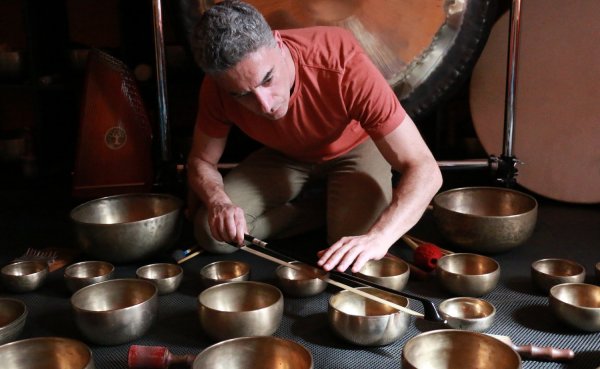
A sound healer uses instruments — typically singing bowls, gongs, tuning forks, chimes, and voice — to create a vibrational environment that supports relaxation, nervous system regulation, and emotional release. Sessions can be one-on-one or in groups. They can take place in wellness studios, private practice, hospitals, corporate settings, yoga studios, retreat centers, or online.
The goal isn't performance. It's presence. It's creating a sonic space where the listener's nervous system can exhale.
Some sound healers work entirely with sound. Others integrate it into existing practices — Reiki, massage, yoga, psychotherapy, coaching. The combination is often more powerful than either alone.
What all good sound healers share: a genuine understanding of how sound works on the body and brain, not just an aesthetic appreciation for beautiful instruments.
First, Let's Get Honest About the Industry
Here's something most "how to become a sound healer" articles won't tell you: the field is completely unregulated.
There is no government body that certifies sound healers. No universal standard. No licensing board. Anyone can call themselves a sound healer tomorrow, buy a bowl on Amazon, and start charging clients by next weekend.
That's a problem — not because certification is magic, but because it means the quality gap between practitioners is enormous. Some are extraordinary. Some are harmful. Most are somewhere in between: well-intentioned but poorly trained.
This isn't meant to discourage you. It's meant to orient you. The fact that standards are self-set means your training choices matter more, not less. What you learn, how deeply you learn it, and who teaches you will define everything about the kind of practitioner you become.
Choose accordingly.
Step 1 — Start With the Science, Not the Instruments
This is the step most people skip. It's also the most important one.
Before you buy a singing bowl, before you book a workshop, before you design a logo — understand how sound works.
That means learning the physics of sound: frequency, amplitude, resonance, overtones, harmonics. It means understanding psychoacoustics — how the brain and nervous system process sound, how entrainment works, what actually happens during a sound bath at a biological level.
It means learning enough music theory to understand consonance and dissonance, why some note combinations feel resolved and others feel tense, why the interval between two bowls matters as much as the bowls themselves.
Why does this come first? Because without this foundation, you'll be hitting things and hoping for the best. Intention is important — but intention without knowledge isn't healing, it's guessing.
The practitioners who study this thoroughly are the ones who can explain what they're doing and why. They're the ones clients trust, return to, and refer others to.
Step 2 — Choose the Right Training
This is where most people get stuck — or misled.
There are hundreds of sound healing training programs available. Weekend workshops. Online certifications. Apprenticeships. Retreat-based immersives. Some cost $20. Others cost $10,000. And the price tag tells you almost nothing about the quality!
Here's what to actually look for:
A curriculum grounded in science. Does it cover acoustics, music theory, and psychoacoustics — or does it jump straight to chakra assignments and healing frequencies? The former builds real competence. The latter builds confidence without foundation.
Accreditation from recognized bodies. Look for programs accredited by organizations like ISTA (International Sound Therapy Association), IICT (International Institute for Complementary Therapists), or CMA (Complementary Medical Association). These aren't government agencies, but they represent professional standards and often unlock insurance eligibility for graduates — which matters when you start working professionally.
Direct access to an experienced teacher. Video libraries are useful. But the ability to ask questions, get personalized feedback, and work through confusion with a real expert is irreplaceable. Look for programs that include one-on-one mentorship, not just pre-recorded content.
A realistic scope. Any program that promises mastery in a weekend is selling something other than education. Genuine competence takes time. Look for programs with enough depth — typically 100 to 200 hours — to actually develop skill.
At Sound Medicine Academy, our 200-hour Sound Healing Certification and 100-hour Sound Bath Training are built on exactly this approach — science first, instruments second, business third. Both are accredited by ISTA, IICT, CMA, and Yoga Alliance, and include direct mentorship with Guy Beider throughout.
Step 3 — Get Your Hands on the Instruments (But Not Yet)
Here's counterintuitive advice: don't buy instruments before you've started your training.
I know. It's tempting. Singing bowls are beautiful. Gongs are magnetic. The impulse to own them immediately is understandable.
But buying instruments before you understand what to listen for is like buying a grand piano before you can tune one. You'll likely end up with something that doesn't serve you — or worse, something that actively limits your practice.
A good training program will teach you how to evaluate instruments — what to listen for in a singing bowl, how to assess the quality of a gong, how to build a coherent set rather than a random collection. It will teach you the difference between a bowl that sings and one that merely rings.
Buy informed, not excited. Your future clients will feel the difference, even if they can't name it.
Step 4 — Practice, Practice, Practice
Certification doesn't make you a sound healer. Practice does.
Once you've built your foundation and assembled your instruments, you need to use them — constantly, intentionally, and with feedback. That means:
Playing every day. Even fifteen minutes. Your hands need to develop sensitivity. Your ears need to develop discernment. That only comes from repetition.
Offering free or low-cost sessions. Friends, family, community groups. Early sessions are for your learning as much as for your participants. You need to discover how people respond, how the energy of a room shifts, how to hold space when someone unexpected happens.
Recording yourself. There is no faster way to hear what you're actually doing versus what you think you're doing. It's uncomfortable. Do it anyway.
Seeking feedback. Not compliments. Real, honest feedback. What landed? What felt scattered? Where did attention drift? A mentor who will tell you the truth is worth more than ten enthusiastic friends.
The goal isn't perfection. The goal is developing the sensitivity to notice what's working and the knowledge to adjust it.
Step 5 — Get Certified
Once you've completed your training and built real practice hours, certification formalizes what you've learned and opens professional doors that would otherwise stay closed.
Specifically:
Insurance eligibility. Working professionally with clients — especially in wellness or clinical adjacent settings — typically requires liability insurance. Graduates of accredited programs like ours are eligible for coverage through Massage Magazine Insurance Plus (MMIP), one of the leading providers in the field.
Professional membership. IICT and ISTA certification, for example, connects you to a global community of practitioners, provides credentials you can list publicly, and signals to potential clients that you've met a recognized standard of training.
Credibility with venues and employers. Yoga studios, wellness centers, retreat organizers, and corporate clients increasingly ask for credentials before booking practitioners. Certification answers that question before it's asked.
A certificate alone doesn't make you skilled. But combined with genuine training and real practice hours, it's a meaningful professional signal.
Step 6 — Start Offering Sessions
This is the part most new practitioners delay too long.
There is no perfect moment to start. There is no point at which you will feel fully ready. Waiting until you feel confident enough is a strategy for never starting.
Start small and be honest about where you are. Offer community sessions at low or no cost. Partner with local yoga studios or wellness spaces. Host a sound bath for your existing community. Volunteer at a hospice, a rehabilitation center, or a community health event.
Real experience accelerates everything that training begins. You'll learn more from your first ten sessions with real participants than from your last ten hours of solo practice.
As you gain experience, the business side becomes clearer — how to price sessions, how to attract clients, how to structure offerings. Our Sound Healing Business Training covers exactly this: from pricing models and session design to digital marketing, Google Business Profile, and securing contracts with studios and institutions.
How Long Does It Actually Take?
Honestly? It depends on how much you put in. But here's a realistic framework:
- Foundation phase (0–2 months): Complete your core training, build theoretical knowledge, choose and acquire your first instruments
- Practice phase (2–6 months): Daily playing, free/low-cost community sessions, getting feedback, refining your approach
- Professional phase (6–9 months): Certified, insured, and offering paid sessions with growing confidence
That's 6 to 9 months from beginner to working practitioner if you're consistent. Some people move faster. Some take longer. Neither is wrong.
What matters more than timeline is depth. A practitioner who took three years to build a real foundation will outlast a dozen who rushed through a weekend course and burned out when clients didn't materialize.
What Does It Cost to Become a Sound Healer?
Let's be straightforward about this. The main costs are:
Training: A rigorous certification program runs between $450 and $2,000 depending on the hours and level of mentorship included. This is your most important investment — don't cut corners here.
Instruments: A functional starting set — two or three quality singing bowls and basic accessories — typically costs between $500 and $800 if you buy well. A gong adds $700 to $6000. Our training includes a buyer's guide to help you spend wisely rather than impulsively.
Insurance: Annual liability coverage for sound healing practitioners is typically $150 to $200 per year through providers like MMIP.
Total: Realistically, $3,500 to $7,000 to get properly equipped and insured. Considerably less than most wellness certifications, and with a strong return potential once you're working.
Is Sound Healing a Viable Career?
Yes — with clear eyes about what that means.
Most practitioners start by integrating sound healing into an existing practice. A yoga teacher adds sound baths to her offering. A massage therapist includes singing bowls in sessions. A therapist or coach uses sound as an opening or closing ritual.
From that base, some grow into full sound healing practices. Group sessions, private clients, corporate wellness contracts, retreat collaborations, teacher training.
The income ceiling is genuinely high for those who commit. A practitioner running two group sessions per week plus a handful of private clients can earn a comfortable living. Our Business Training breaks down exactly how — including realistic income projections and the client acquisition strategies that actually work.
What it requires: consistency, genuine skill, and the patience to build a reputation slowly and sustainably. This is not a get-rich-quickly path. It is a get-good-slowly path — which tends to be the only kind worth walking.
A Final Honest Word
Sound healing can be a profound practice and a meaningful profession. But it only becomes both when it's approached with the seriousness it deserves.
The people who make a real difference with this work — the ones clients remember, return to, and send their friends to — are not the ones who bought the prettiest bowls or completed the fastest certification. They're the ones who took the time to truly understand what they're doing and why.
That's the path worth taking.
If you're ready to start it properly, explore our courses or take a free preview of the 200-hour certification to see what a science-based, mentorship-led training actually looks like from the inside.
And if you're still deciding — read our sound healing FAQ. Every honest question you have is probably answered there.
FAQs
Do I need a music background to become a sound healer?
No. In fact, some musical training can create habits that work against sound healing — like prioritizing performance over presence. What matters is your willingness to listen deeply and learn from the ground up.
Is there a government certification for sound healing?
No. As of 2026, no government body globally certifies sound healers. Certification comes from private institutions and associations. The quality and rigor of your program matters far more than the certificate itself.
Can I learn sound healing online?
Yes — and a good online program can be just as rigorous as in-person training, provided it includes direct mentorship and real feedback, not just video content. Our online certification includes one-on-one sessions, homework reviewed by Guy Beider personally, and lifetime access to all materials.
What instruments do I need to start?
Two or three quality singing bowls and basic accessories are enough to begin practicing and offering early sessions. Don't buy more until you understand what you're listening for. Your training should teach you this.
How do I find my first clients?
Start with community. Friends, family, local yoga studios, wellness events. Don't wait until you feel ready — start when you're trained and keep learning as you go.