Table of Contents
- A Science-Based Guide to How It Actually Works
- What Tuning Fork Therapy Actually Is
- The Real Mechanism — And the Explanation Almost Everyone Gets Wrong
- Does Tuning Fork Therapy Work? Applying an Actual Evidence Framework
- Do Tuning Forks Help With Pain?
- Tuning Fork Therapy Side Effects and Safety
- What Tuning Fork Therapy Is Not
- Learn to Do This Properly
- FAQs
A Science-Based Guide to How It Actually Works
Search "tuning fork therapy" and you'll find two completely different conversations happening at once. One camp says a 528 Hz fork repairs your DNA. The other dismisses the entire practice as pseudoscience with a tuning fork attached. Neither is telling you the truth.
Here's the actual answer: tuning fork therapy is a real, physiologically grounded practice with a legitimate — if modest and still-developing — evidence base. It is not medical treatment, it doesn't cure disease, and most of the specific frequency claims you've read online don't hold up. But the underlying mechanism, the reason a struck piece of metal against your skin produces a genuine relaxation response, is well-documented neuroscience. You just haven't seen it explained honestly, because almost nobody in this industry bothers to.
This article does that. No mysticism, no overclaiming, no vague "healing frequency" language. Just what tuning forks are, what happens in your body when one touches your skin, what the research actually shows, and where the real limits are.
What Tuning Fork Therapy Actually Is
A tuning fork is a two-pronged metal instrument that vibrates at a fixed frequency when struck. Tuning fork therapy applies that vibration to the body — either through direct skin contact or by holding the fork near the ears — as a relaxation and body-awareness practice.
That's the whole technique. What varies is the type of fork and where it's applied.
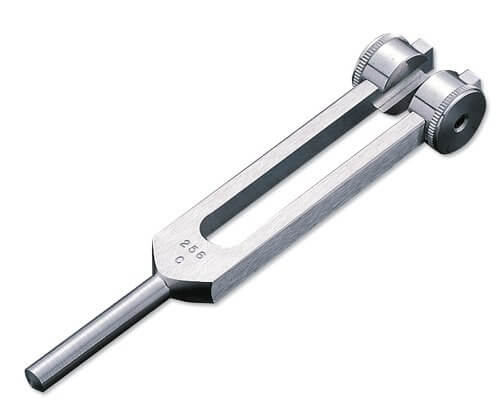
Weighted tuning forks have small metal weights added to the tips of the tines. Struck, the vibration concentrates down into the stem rather than radiating outward as sound, which makes them the right tool for direct body contact — placed on bone, joint, or muscle so the vibration is felt rather than heard. This is the category people are searching for when they type "weighted tuning forks" or ask about weighted vs. unweighted sets — it's one of the more common transactional searches in this space, and for good reason: it's the single most important distinction to understand before buying anything.
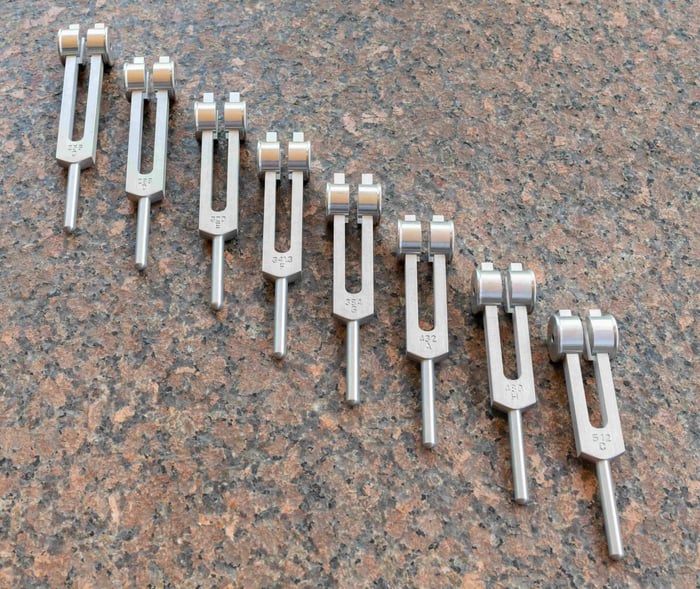
Unweighted tuning forks have no added mass. They produce a louder, clearer audible tone with much less felt vibration through the stem, which makes them the right choice for off-body work — held near the ears or moved through the space around a client rather than pressed against skin.
The rule that governs almost every technique decision: if it's going to touch the body, it should generally be weighted. If it's staying off the body, unweighted. Confusing the two is one of the most common technique mistakes in this field.
You'll also see forks marketed in wildly different frequency families that have nothing to do with each other despite sharing a unit of measurement. Medical-grade forks (128 Hz, 256 Hz, 512 Hz) are standardized clinical tools used in actual neurological and hearing exams — not part of the wellness tradition at all. Otto or "body tuner" sets (32–128 Hz) are weighted forks built specifically for musculoskeletal work. Solfeggio frequencies sets (174–963 Hz) are a modern marketing framework with contested historical origins and, as you'll see below, a very thin evidence base behind most of the claims attached to them. Treating all of these as interchangeable "healing frequencies" is exactly the kind of imprecision that gives this entire field a bad name.
The Real Mechanism — And the Explanation Almost Everyone Gets Wrong
Ask most practitioners why tuning fork vibration feels calming and you'll get some version of "it activates your body's natural relaxation response." True, and completely unhelpful. Here's the specific, defensible version.
Human skin contains several types of mechanoreceptor — nerve endings tuned to different kinds of mechanical input. The one that matters here is the Pacinian corpuscle, a receptor sitting deep in the skin that's specifically built to detect vibration and deep pressure. When a struck tuning fork contacts skin, Pacinian corpuscles are the primary receptor being activated. That's the honest, one-sentence, physiologically accurate answer to "why does this work."
Now for the correction. You'll frequently see practitioners cite C-tactile afferents — a separate class of nerve fiber tied to feelings of calm — as the reason vibration feels good. This is a real mechanism, and it's genuinely misapplied here. C-tactile afferents respond specifically to slow, gentle, caress-like stroking at a very particular velocity, roughly 1–10 cm per second. That's the mechanism behind why a slow massage stroke feels good. A struck tuning fork held at a fixed point on the skin is a completely different tactile input — sustained vibration, not a moving caress — and it doesn't engage this pathway. If you read a description of tuning fork therapy that leans on C-tactile afferents, that's a sign the source hasn't done its homework.
What vibration does reliably influence is the balance between your sympathetic ("fight or flight") and parasympathetic ("rest and digest") nervous systems, largely through vagal tone — the activity of the vagus nerve, your parasympathetic system's main channel. Mechanical vibrational input is one of many inputs, alongside breathwork and massage, that can shift this balance toward parasympathetic dominance. If you want the fuller picture of how sound and vibration interact with the nervous system more broadly, we've covered that mechanism in more depth here.
The strongest research anchor for any of this is a related but distinct clinical field: vibroacoustic therapy (VAT), which uses low-frequency sound (commonly around 40 Hz) delivered through purpose-built devices — vibrating platforms, mattresses, chairs. Reviews of VAT research show improvements in motor function, pain reduction, heart-rate-variability shifts toward parasympathetic dominance, and improved sleep metrics. Here's the honesty gap worth naming directly: this research uses sustained, controlled vibration from powered devices. A hand-struck tuning fork is a brief, higher-frequency, decaying input — a genuinely different stimulus. The mechanisms are plausible by direct analogy. Nobody has specifically studied hand-held tuning forks the way VAT devices have been studied. Any practitioner who tells you otherwise is stretching the citation past what it actually shows.
More recent research adds a second layer: a 2026 review of myofascial release mechanisms explicitly names vibration and acoustic stimulation, alongside manual pressure and stretch, as categories of mechanical loading that deform connective tissue and trigger cellular-level signaling — a process called mechanotransduction. This is real, current cell biology. It's also a demonstrated cellular mechanism, not yet a proven clinical outcome for any specific technique, and that distinction matters more than it usually gets credit for.
Does Tuning Fork Therapy Work? Applying an Actual Evidence Framework
"Does it work" isn't a yes-or-no question, because it depends entirely on what you're claiming. The most useful way to answer it is to sort every claim into one of four categories, and apply that framework honestly rather than picking whichever label makes the marketing sound better.
Established science. Basic anatomy, mechanoreceptor physiology, and the general relaxation response are settled, textbook-level findings. Not in dispute.
Emerging evidence. Real research exists, findings are promising, but it isn't large or consistent enough to call settled. The strongest example in the entire field is PC6 (Neiguan), a point on the inner forearm. A meta-analysis of 30 randomized controlled trials covering more than 2,500 patients found PC6 acupressure produced a statistically significant reduction in postoperative nausea and vomiting. That's real, replicated evidence — for acupressure specifically. Tuning fork vibration applied at that same location hasn't been separately studied, so the honest claim is that this is a well-evidenced acupressure point being extended by plausible mechanism, not a proven result for the instrument itself.
Traditional knowledge. Points like GB20 (Wind Pool, at the base of the skull) come from centuries of observation within Traditional Chinese Medicine. GB20 sits close to the greater occipital nerve, a real anatomical structure with a well-established role in tension headaches — a rare case where the traditional framing and modern anatomy point at the same real structure. That convergence is genuinely interesting. It's still not the same thing as a clinical trial proving tuning fork stimulation there treats headaches.
Speculative. This is where most of what you'll find on Google actually lives. "528 Hz repairs your DNA" is one of the most common claims in the entire sound healing industry, and the human evidence behind it is a single small study finding some short-term stress-marker changes after five minutes of listening. That's the entire human evidence base. The DNA-repair claim has none — we go through exactly what the research does and doesn't say about 528 Hz and 432 Hz here.
The pattern worth internalizing: the field has real science underneath it. The marketing built on top of that science almost always claims more than the science supports.
Do Tuning Forks Help With Pain?
This is one of the most commonly asked questions, and the honest answer is: plausibly, for some kinds of discomfort, through the mechanisms above — but there's no large body of research testing tuning forks specifically against pain. The closest supporting evidence comes from the broader acupressure and manual-therapy literature, where pain, nausea, and sleep consistently show up as the strongest-evidenced outcome categories. That's a reasonable basis for offering tuning fork work as a relaxation-oriented complement to pain management. It is not a basis for claiming tuning forks treat or cure a pain condition, and any practitioner telling you they do is overstating their scope.
Tuning Fork Therapy Side Effects and Safety
Used appropriately, tuning fork work carries a low risk profile — this is gentle, external, non-invasive contact. That said, "low risk" isn't "no screening needed." A few areas warrant real caution: the base of the skull and neck (due to nearby vertebral artery and occipital nerve anatomy), the chest for anyone with a pacemaker or implanted cardiac device, certain points during pregnancy, recent fractures or joint replacements, and osteoporosis with a spinal fracture history. A properly trained practitioner screens for all of this before a session, not after something goes wrong. If a practitioner doesn't ask you health-screening questions before working near your neck or chest, that's a red flag worth noticing. (If you're a practitioner reading this and thinking about your own liability exposure around screening and scope, this is worth a look.)
What Tuning Fork Therapy Is Not
It's not a substitute for medical care. It doesn't diagnose, treat, cure, or prevent any disease. A legitimate practitioner will tell you this directly, not bury it in fine print. What a well-trained practitioner can offer is a genuinely evidence-informed sensory experience — grounded in real anatomy, real physiology, and an honest account of where the current research stops.
Learn to Do This Properly
Most of the confusion around tuning fork therapy exists because most training in this field never bothers to separate established science from traditional practice from outright speculation. Sound Medicine Academy's 200-hour Sound Healing Certification teaches exactly that distinction — real anatomy, real physiology, the actual research behind each classical point, and where every claim genuinely stands — so you can practice, or receive this work, with your eyes open instead of on faith. Prefer a lighter entry point? The 100-hour Sound Bath Certification and the Sound Healing for Beginners course cover the same evidence-first approach at a smaller scale. And if you're still deciding whether this training is the right fit, here's what makes it different from most sound healing schools.
FAQs
Can tuning forks be dangerous?
Used correctly, no — it's gentle, external contact. The real risk comes from poor technique: firm pressure at the base of the skull (near the vertebral artery) or chest work on someone with a pacemaker. A trained practitioner screens for both before touching a client.
What tuning forks do doctors actually use — are they the same as "healing" ones?
Doctors use 128 Hz and 512 Hz forks for nerve and hearing tests — the Rinne and Weber tests specifically. A wellness practitioner might use the exact same frequency fork, but using it isn't performing a diagnostic exam. Same object, completely different scope.
Is tuning fork therapy just New Age, or is there real science behind it?
Both, depending on which claim you mean. The physiological mechanism — vibration activating skin mechanoreceptors and shifting nervous system balance — is mainstream neuroscience. Many of the frequency-specific claims layered on top of it are New Age framing with no research behind them. The instrument is legitimate; not every story told about it is.
Can tuning fork therapy help with tinnitus?
There's no meaningful clinical research testing tuning forks against tinnitus specifically. Anyone claiming a fork treats tinnitus is making an unsupported claim — tinnitus should be evaluated by a doctor, not addressed through wellness sessions alone.
Does 528 Hz actually have any proven health benefits?
One small study found short-term stress-marker changes after five minutes of listening. That's the entire human evidence base. The much more common claim — that it "repairs DNA" — has no scientific support anywhere in the literature.
Can tuning fork therapy help you lose weight?
No. There's no mechanism by which vibration from a tuning fork affects weight, and no research suggesting it does. This is one of the clearer examples of a claim with zero evidentiary basis in this field.
What are the spiritual benefits of tuning fork therapy, and are they backed by evidence?
Many people find real personal or spiritual meaning in tuning fork sessions — that's a genuine, valid experience, but it's a different kind of claim than a clinical outcome, and research doesn't measure "spiritual benefit" the way it measures nausea reduction or heart rate. Worth enjoying on its own terms without needing a scientific study to validate it.
Are there contraindications for tuning fork therapy?
Yes — pregnancy (for specific points), pacemakers or implanted devices, recent fractures or joint replacements, osteoporosis with spinal fracture history, and recent neck injury near the base of the skull all warrant screening or avoidance of specific areas.
Can tuning fork therapy help with anxiety?
- Plausibly, through the same general relaxation mechanism that helps with stress broadly — shifting the nervous system toward parasympathetic dominance. There's no tuning-fork-specific clinical trial for anxiety disorders, so it's reasonable as a complement to care, not a replacement for it.
What is tuning fork therapy actually called — is "tuning fork healing" the same thing?
"Tuning fork therapy," "tuning fork healing," and "tuning fork sound therapy" are used interchangeably in casual and marketing language — there's no formal, standardized clinical name, because it isn't a recognized medical treatment. That's worth knowing before trusting any source that uses clinical-sounding terminology to describe it.