Table of Contents
- Why I'm Debunking a Sound With Sound
- The Claim, in One Paragraph
- Listen: The Nine Solfeggio Frequencies
- Test 1: Is This Really the Ancient "Ut, Re, Mi"?
- Were They Really Suppressed by the Church?
- Test 2: The "Miracle Tone" Is a Slightly Sharp C
- Where the Numbers Really Come From
- What About the Studies?
- Why Solfeggio Music Still Makes People Feel Better
- How to Spot a Frequency Myth
- What I Teach Instead
- About the Author
- Sources
- FAQs
The short answer: Solfeggio frequencies are real sounds, but not an ancient scale, and they have no proven healing powers. The numbers were worked out in the 1970s using numerology, not acoustics. Play them and you'll hear they don't even form the medieval "ut, re, mi" they're named after. And the famous 528 Hz "miracle tone" is simply a C, tuned a little sharp.
Why I'm Debunking a Sound With Sound
Students ask me about Solfeggio frequencies almost every week. Some arrive excited, having spent months falling asleep to 528 Hz playlists. Others arrive embarrassed, because a client asked them which frequency heals anxiety and they didn't know what to say.
I've written about the history and the numerology before. But a claim about sound deserves a test you can hear, not just another article to read. So for this one I made three short recordings. Each clip tests one claim. You don't have to take my word for anything: put on headphones, listen, and judge for yourself.
All three clips were generated digitally, so every frequency is exact. I checked each one with a spectrum analyzer before publishing.
The Claim, in One Paragraph
Here's the story as you'll find it on hundreds of websites. The Solfeggio frequencies are a set of sacred tones (usually six, sometimes nine) used by medieval monks in Gregorian chant. They correspond to the syllables ut, re, mi, fa, sol and la from an 11th-century hymn. The Church suppressed them, and they were rediscovered in the 1970s. Each tone has a specific power: 396 Hz releases guilt, 417 Hz undoes trauma, and 528 Hz, the "miracle tone", repairs DNA.
Almost every part of that story can be checked, and almost every part fails. Let's start by listening.
Listen: The Nine Solfeggio Frequencies
This clip plays all nine tones as pure sine waves, from lowest to highest, 2.5 seconds each.
| Time | Frequency | What it's claimed to do |
|---|---|---|
| 0:00 | 174 Hz | Relieve pain |
| 0:03 | 285 Hz | Regenerate tissue |
| 0:06 | 396 Hz | Release fear and guilt |
| 0:09 | 417 Hz | Undo past trauma |
| 0:13 | 528 Hz | Repair DNA; "love frequency" |
| 0:16 | 639 Hz | Heal relationships |
| 0:19 | 741 Hz | Detoxify cells |
| 0:22 | 852 Hz | Awaken intuition |
| 0:25 | 963 Hz | Connect to the divine |
What you just heard is nine plain tones that sound much like a hearing test. Pay attention to two things. First, nothing about any single tone sounds special. Second, the steps between them are uneven. Some are small, some are large, and the sequence doesn't feel like a scale or a melody. Hold on to that second observation, because it's the key to the first test.
Test 1: Is This Really the Ancient "Ut, Re, Mi"?
The name "Solfeggio" comes from solfège, the system singers still use to learn melodies: do, re, mi, fa, sol, la, ti. It really is medieval. Around 1025, the monk Guido d'Arezzo noticed that the hymn Ut queant laxis, sung for the feast of St. John the Baptist, has a useful property: each of its first six phrases starts one step higher than the last. He took the first syllable of each phrase (ut, re, mi, fa, sol, la) and used them to teach choirboys to sing new melodies at sight. "Ut" was later replaced by "do".
The Solfeggio story claims that the six original tones (396, 417, 528, 639, 741 and 852 Hz) are ut, re, mi, fa, sol and la. Here's the problem: Guido's syllables never named fixed pitches. They named steps, the distances between notes. Ut to re is a whole step, re to mi a whole step, mi to fa a half step, then two more whole steps. A choir could start ut on any pitch that suited its voices, as long as the steps stayed the same.
So the test is simple. If the six Solfeggio tones really were ut, re, mi, fa, sol and la, the steps between them would follow that pattern. Musicians measure steps in cents: 100 cents is a half step, and 200 cents is a whole step.
In this clip you'll hear the six Solfeggio frequencies played as a melody. After a short pause, you'll hear the real medieval ut, re, mi, fa, sol, la, starting on the same 396 Hz and tuned the way medieval musicians tuned, in pure Pythagorean ratios.
| Step | Real ut-re-mi (cents) | Solfeggio tones (cents) |
|---|---|---|
| Ut → Re | 204 (whole step) | 90 (396 → 417 Hz) |
| Re → Mi | 204 (whole step) | 409 (417 → 528 Hz) |
| Mi → Fa | 90 (half step) | 330 (528 → 639 Hz) |
| Fa → Sol | 204 (whole step) | 256 (639 → 741 Hz) |
| Sol → La | 204 (whole step) | 242 (741 → 852 Hz) |
The second version sounds like the start of a scale you learned as a child. The first sounds like a random set of notes, because it is one. The Solfeggio "re" is less than a half step above "ut". The jump to "mi" is wider than a major third. None of the steps match.
There's an irony at the end of this test. If you build a genuine medieval scale on 396 Hz, it does contain 528 Hz exactly. But 528 Hz lands on fa, not mi. The one place the "love frequency" fits the old system is the syllable the story doesn't assign to it.
Were They Really Suppressed by the Church?
The second half of the story says the Church hid these tones, which is why nobody heard of them until the 1970s. This is the easiest part to check, and it falls apart quickly.
Guido's system was never hidden. It spread through monasteries and cathedral schools across Europe within decades, because it made training a choir so much faster. His own letter explaining the method, written around 1030, survives and is still studied. Singers used ut, re, mi, fa, sol and la for centuries, and the syllables are still taught in every music school today as do, re, mi.
What you won't find anywhere in that long record is a list of frequencies, a healing claim attached to a syllable, or a ban. A secret can't be suppressed for nine hundred years while it's taught openly to choirboys all over Europe. The simpler explanation is that the healing version of the story didn't exist until someone wrote it in the 20th century.
Test 2: The "Miracle Tone" Is a Slightly Sharp C
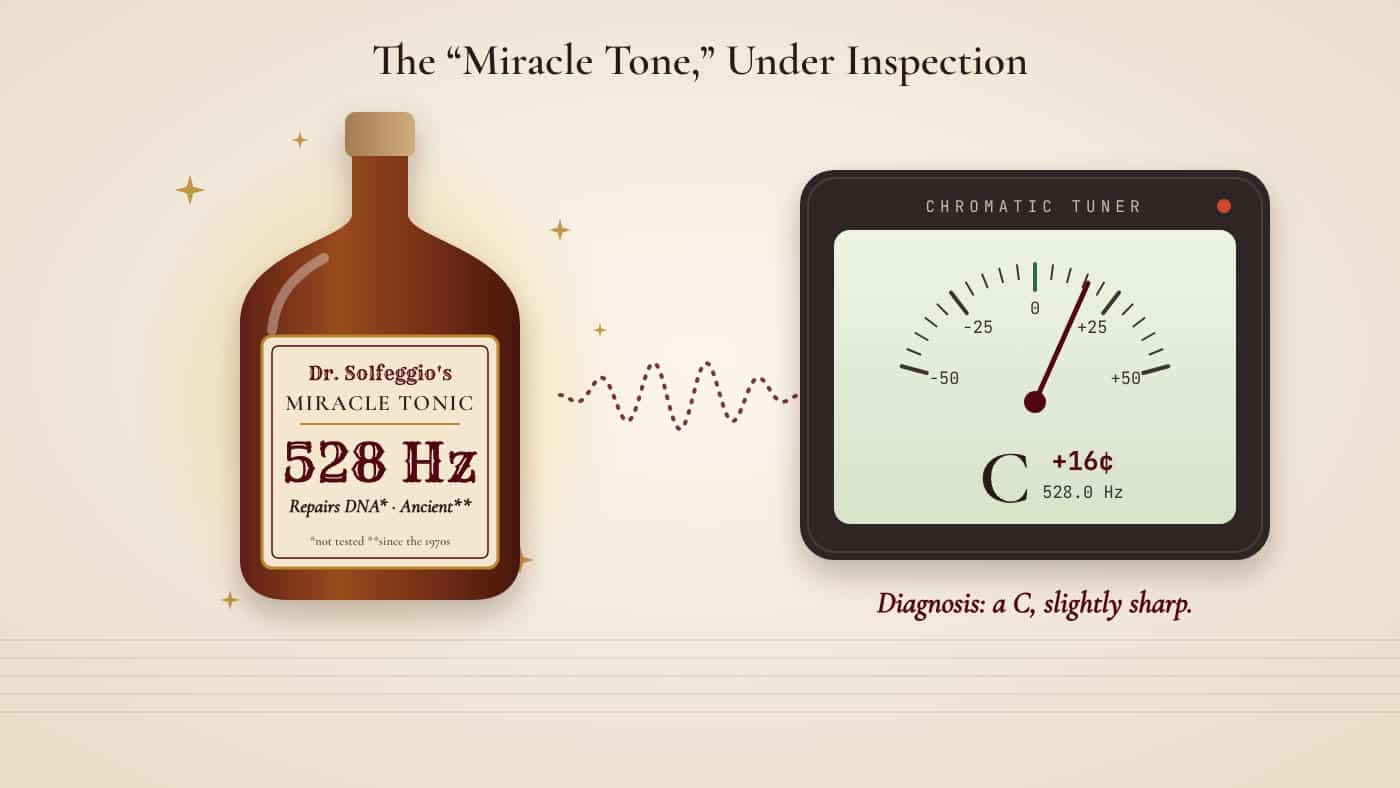
Now for 528 Hz itself. On a piano tuned to the modern standard, where the A above middle C is 440 Hz, the C an octave above middle C is 523.25 Hz. The "miracle tone" is 4.75 Hz higher than that. In musical terms, it's 16 cents sharp, about a sixth of a half step.
The clip plays 528 Hz (A), then the standard C at 523.25 Hz (B), then both again. Most listeners can't reliably tell which is which. At the end, both tones play together, and you'll hear a slow wobble, about five pulses per second. That wobble is called beating. It's the sound of two pitches that are almost, but not quite, the same.
Another way to say it: tune your A to 444 Hz instead of 440 Hz, and your C becomes exactly 528 Hz. Some musicians do this and advertise their music as "tuned to 528". The music hasn't gained any special property. It has been retuned by about a sixth of a half step.
This is also why the popular story about John Lennon's "Imagine" doesn't work. The song is in C major and was recorded at standard tuning, so its C sits near 523 Hz. The "528 Hz versions" you can find online are retuned copies, pitched slightly higher than the original. There's no evidence Lennon ever tuned to 528 Hz, and a song isn't "in" a frequency in the first place. It moves through dozens of them.
If a healing effect depended on 528 Hz exactly, it would have to vanish at 523 Hz, a difference most trained musicians can't hear without a reference. Real instruments drift that much as a room warms up. No physical or biological mechanism has been proposed that could tell the two apart, let alone repair DNA at one and not the other.
Where the Numbers Really Come From
If the tones don't come from acoustics or from medieval music, where do they come from? Look at the six original numbers written in a column:
| Frequency | Hundreds | Tens | Units |
|---|---|---|---|
| 396 | 3 | 9 | 6 |
| 417 | 4 | 1 | 7 |
| 528 | 5 | 2 | 8 |
| 639 | 6 | 3 | 9 |
| 741 | 7 | 4 | 1 |
| 852 | 8 | 5 | 2 |
Each column simply counts upward, wrapping from 9 back to 1. Add the digits of any of them and reduce to one digit (3 + 9 + 6 = 18, then 1 + 8 = 9), and you always land on 3, 6 or 9. These are patterns in written digits, not in sound.
According to the story he told, Dr. Joseph Puleo found these so called Solfeggio frequencies numbers in the 1970s by applying this kind of digit reduction to verse numbers in the Book of Numbers. They reached a wide audience in 1999 through Healing Codes for the Biological Apocalypse, a book he co-wrote with Leonard Horowitz. Later lists added 174, 285 and 963 Hz to make nine.
Here's why the digit patterns can't be meaningful: they depend entirely on the unit. A hertz is one vibration per second, and the second is a human convention. It began as a 60th of a 60th of a 24th of a day, a way of dividing time inherited from ancient Egyptian and Babylonian astronomy, and since 1967 it has been defined by vibrations of the cesium atom. The name "hertz" was adopted only in 1930. Count the same 528 vibrations per minute instead of per second, and the tone becomes 31,680 vibrations per minute. The digits change, the 3-6-9 pattern disappears, and the sound stays exactly the same.
Sound doesn't know what units we use. Acoustics works in ratios: an octave is 2:1, a perfect fifth 3:2, a fourth 4:3. Those relationships are the same in any unit and any century. That's why a medieval choir could sing perfect fifths without a clock. It's also why it couldn't have sung "528 Hz" on purpose: it had no seconds to count in, and there was no international pitch standard until 1939.
What About the Studies?
You'll see claims that "studies show" Solfeggio frequencies reduce anxiety or boost serotonin. When you trace them, you usually find either nothing or one small study.
The most cited is a 2018 Japanese study in which nine healthy adults listened to five minutes of piano music tuned to 528 Hz and, on another day, to 440 Hz. Their cortisol dropped after the 528 Hz version. That's interesting, but nine people, no silence condition and no control for expectation don't make a finding. Nothing in it concerns DNA. I review that study and the 432 Hz research in detail in my article on healing sound frequencies.
What decades of music research do support is less exciting and more useful: calm, slow, predictable music lowers stress for most people. No particular number is needed.
Why Solfeggio Music Still Makes People Feel Better
None of this means people who love these playlists are imagining their calm. The effect is real. It just doesn't come from the label.
Most "Solfeggio" tracks share the same ingredients: very slow tempo, long sustained drones, soft attacks, lots of reverb and no sudden changes. That is a recipe for relaxation at almost any frequency. Add a dark room, headphones, a few quiet minutes and the expectation of healing, and the nervous system does what it does in any safe, quiet setting. It slows down.
In fact, many tracks sold as "528 Hz" don't contain a strong 528 Hz tone at all. They're ambient music with a number in the title. You can check one yourself with a free frequency analyzer.
The calm is worth having. It's the explanation that needs correcting, because a practitioner who believes in magic numbers stops paying attention to what actually works.
How to Spot a Frequency Myth
The same pattern shows up behind 432 Hz, "chakra tones", "DNA activation" and the next trend after them. Five questions will catch most of them:
- Is the claim tied to an exact number of hertz? Real acoustic effects come from relationships between sounds and from how sounds change over time, not from a single magic number.
- Does the history hold up? "Ancient" and "hertz" can't share a sentence. Precise frequencies are a modern measurement.
- Would the effect survive a small change? If 528 Hz heals and 523 Hz doesn't, ask what in the body could tell the difference.
- Where's the controlled study? Look for comparisons against silence or against other equally relaxing music, with more than a handful of people.
- Who is selling what? Notice whether the claim comes attached to a playlist, a tuning fork set or a course.
What I Teach Instead
I don't think the answer to frequency myths is cynicism about sound healing. Sound changes how we feel and how our nervous system behaves, and that's worth studying seriously. The principles that actually explain it are:
- Intervals and consonance: why some pitch combinations feel stable and others tense.
- Overtones and timbre: why a singing bowl and a sine wave at the same pitch feel nothing alike.
- Rhythm and dynamics: how tempo and loudness guide breathing and attention.
- The listener: attention, intention and safety.
This is the foundation of our 200-hour sound healing certification. If you're new and want to start with the basics, the sound healing course for beginners is the place to begin. For the full list of Solfeggio claims and their history, see Solfeggio frequencies: the claims vs. the science.
About the Author
Guy Yair Beider has practiced sound healing since 2007 and has led hundreds of sound journeys since 2010. He founded Sound Medicine Academy, an IICT, CMA, and ISTA-accredited school that teaches sound healing through acoustics, psychoacoustics and music theory, and curates antique Himalayan singing bowls at Bells of Bliss.
Sources
- Akimoto, K., Hu, A., Yamaguchi, T., Kobayashi, H. (2018). Effect of 528 Hz Music on the Endocrine System and Autonomic Nervous System. Health, 10(9).
- Puleo, J., Horowitz, L. G. (1999). Healing Codes for the Biological Apocalypse. Tetrahedron Publishing.
- Interval and frequency figures are calculated from the tones themselves: cents = 1200 × log₂(f₂ / f₁).
FAQs
Are Solfeggio frequencies real?
They're real sounds you can play and hear, but they aren't an ancient scale and have no proven healing powers. The numbers were derived in the 1970s using numerology, and they don't even follow the medieval ut-re-mi pattern they're named after.
Is frequency healing real?
Sound can genuinely calm the nervous system and lower stress, and that's well supported. What isn't supported is the idea that a specific frequency heals a specific organ, emotion or gene. The calming effect comes from the music and the listening, not from the number of hertz.
What does 528 Hz do to the human body?
Like any gentle sound, it can help you relax if you find it pleasant. There's no evidence it repairs DNA or has unique effects. One study of nine adults found lower cortisol after 528 Hz piano music, but it had no silence condition and nothing to do with DNA.
What happens if you listen to 528 Hz every day?
Most likely, you'll have a regular few minutes of calm, which is valuable in itself. Any benefit comes from the habit of quiet, focused listening. Music tuned 5 Hz lower would do the same. Keep the volume moderate, as with any daily listening on headphones.
What is the best Solfeggio frequency?
None of them is better than the others for health. The best sound for relaxation is one you find pleasant, played at a comfortable volume, slowly and without sudden changes. For many people that's a singing bowl, a soft drone or slow music, whatever its frequency.
Which Solfeggio frequency is good for sleep?
No Solfeggio frequency has been shown to improve sleep more than other calm sounds. What helps is low volume, slow tempo, no sudden changes and a consistent routine. If a 174 Hz or 528 Hz track helps you fall asleep, the routine and the soft sound are doing the work.
What happens if you listen to 963 Hz?
You hear a high, thin tone, between B-flat and B about two octaves above middle C. It won't activate your pineal gland or connect you to the divine. Pure tones this high can feel tiring after a few minutes, so keep the volume low.
What is God's frequency in Hz?
No frequency belongs to God. 963 Hz is often marketed as the "frequency of the gods", but that label comes from 20th-century numerology, not from scripture, tradition or science. Many traditions use sound in worship, but none of them prescribes a number of hertz.
What is the difference between 432 Hz and 963 Hz?
They're different kinds of claims. 432 Hz is a tuning: setting the A above middle C to 432 instead of 440. 963 Hz is a single tone from the Solfeggio list. Neither has proven health effects, and a whole piece of music can't be "in" one frequency.
What are the 7 chakra frequencies?
Charts usually assign 396 Hz to the root chakra and continue to 963 Hz at the crown, but the assignments differ from site to site. They come from recent New Age writing. Traditional chakra texts describe sounds and syllables, never frequencies in hertz.